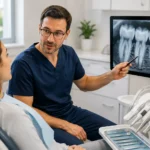
Being told you may need root canal treatment often answers one question and creates another: who should treat the tooth?
Many root canal treatments can be managed by a general dentist. In other cases, specialist assessment may be useful because of the complexity of the tooth, previous treatment, dental trauma, persistent symptoms or uncertainty about the diagnosis.
A referral to an endodontist does not necessarily mean something has gone wrong. Often, the deciding factor is simply that the tooth requires more focused endodontic assessment or treatment.
At myEndodontist, we focus specifically on endodontic care, including the diagnosis and treatment of problems involving the dental pulp and root canal system. Our work includes root canal treatment, retreatment of previously treated teeth, endodontic surgery, dental trauma care and assessment of difficult tooth-related pain.
We also see patients seeking another opinion about whether a natural tooth may be preserved where clinically appropriate.
Understanding when specialist care may be useful can make the next decision much clearer.
When Should You See an Endodontist for a Root Canal?
Not every root canal needs specialist treatment.
Two teeth may require treatment for broadly similar reasons but present very differently during examination. One may have relatively straightforward anatomy and a clear diagnosis. Another may involve narrow or curved canals, previous treatment, a crack, persistent infection or symptoms that do not point clearly to one source.
That difference matters because endodontics deals with structures that are largely hidden inside the tooth.
An endodontist has additional training in this area beyond general dental training, with a clinical focus on the dental pulp, root canal system and tissues surrounding the roots.
Australian registration data reflects how specialised this field is. According to Ahpra and the Dental Board of Australia, 215 dental practitioners were registered in the specialty of endodontics nationally as at 31 December 2025, including 50 in Queensland.
At our North Lakes practice, that specialist focus is supported by equipment including dental operating microscopes with fluorescence technology, digital imaging and a 3D dental scanner.
Not every tooth needs specialist care. The more useful question is whether the individual tooth would benefit from specialist endodontic expertise.
What a root canal specialist actually does
The term root canal specialist is commonly used by patients searching for an endodontist.
The role extends beyond carrying out root canal treatment. Diagnosis is an important part of endodontic care.
Before treating a tooth, the clinician needs to understand what is happening inside it, whether the symptoms are coming from that tooth, whether previous treatment has altered the anatomy and whether preserving the tooth is a reasonable clinical objective.
An endodontist may become involved when a patient has:
- a complex root canal problem
- persistent or difficult-to-explain tooth pain
- a tooth that has already undergone root canal treatment
- suspected or known complicated canal anatomy
- a cracked, fractured, displaced or traumatised tooth
- a recommendation for treatment they would like assessed further
- concerns about whether a tooth can reasonably be retained
The question is not, “Does everyone who needs a root canal need a specialist?”
They do not.
A better question is, “Is there something about this particular tooth that makes specialist assessment valuable?”
Complex Root Canal Cases May Benefit From Specialist Care
The outside of a tooth can look deceptively simple.
Inside, the root canal system may be much more complex. Canals can be narrow, curved or difficult to locate. Calcification can make access more challenging. Additional anatomy may be present, and previous dental work can change the route available to reach and clean the canal system.
These are not details most patients can identify themselves, and symptoms alone rarely reveal them.
This is why the circumstances of the case often matter more than the intensity of the pain.
| Situation | Why specialist input may be useful |
| Narrow, curved or difficult-to-locate canals | The internal anatomy may be harder to identify and manage |
| Previous root canal treatment | Existing root filling material and altered anatomy can make further treatment more complex |
| Persistent or unclear symptoms | Careful diagnosis may be needed before further treatment is considered |
| Dental trauma or cracks | The condition of the pulp, tooth structure and surrounding tissues may need closer evaluation |
| Uncertainty about preserving the tooth | A specialist opinion may help clarify whether endodontic treatment has a reasonable role |
Complex root canal anatomy can make treatment more demanding
Root canal treatment involves removing diseased pulp tissue, cleaning and shaping the internal canal system, disinfecting it and sealing the space.
The aim is to treat infection or inflammation within the tooth while retaining the natural tooth where clinically appropriate.
That process depends on being able to identify and manage the relevant anatomy.
When canals are particularly narrow or curved, or when parts of the internal anatomy are difficult to visualise, magnification and detailed imaging may help the clinician understand the tooth before and during treatment.
At myEndodontist, our specialist environment includes dental operating microscopes and 3D dental scanning technology for diagnostic and treatment planning purposes.
Technology does not determine the outcome by itself. Its value lies in supporting detailed visualisation, specialist assessment and clinical judgement.
A Previous Root Canal That Is Still Troubling You Deserves a Fresh Assessment
A tooth that has already had root canal treatment introduces another layer of complexity.
Sometimes a previously treated tooth does not heal as expected. In other cases, it settles initially and develops a new problem later.
The symptoms alone do not tell us why.
Possible factors include anatomy that was difficult to reach during the original procedure, including narrow or curved canals. Other possible causes include new decay, salivary contamination, a cracked or loose crown or filling, tooth fracture, or infection or pain developing around an old root canal.
Each possibility changes the clinical question.
Root canal retreatment can address problems that appear later
Root canal retreatment involves reopening a previously treated tooth so the existing root filling material can be removed and the internal system examined again.
The tooth can then be assessed for issues such as additional canals, infection, cracks or other factors that may be contributing to the problem.
Where retreatment is suitable, the canals are cleaned, shaped, disinfected and filled again.
Before that happens, the first question is whether retreatment is actually the appropriate next step.
A tooth that hurts after previous root canal treatment is not a diagnosis in itself. The cause still needs to be established.
Specialist assessment can help determine whether retreatment is suitable
This is one of the clearer situations in which patients may seek an endodontist.
The aim is not simply to repeat the original procedure. It is to understand why the tooth remains problematic and whether another endodontic approach has a reasonable role.
Depending on the findings, the discussion may involve retreatment, endodontic surgery, monitoring or another treatment pathway.
Not every previously treated tooth can be retained. A careful examination can, however, help clarify the available options and support a better-informed decision.
When Tooth Pain Is Difficult to Diagnose
Tooth pain can feel very specific even when the source is not immediately clear.
A patient may be convinced that one particular tooth is responsible, yet pain in the mouth and face can sometimes be difficult to localise.
At myEndodontist, diagnosis of odontogenic pain forms part of our specialist care. This can include cases where the source of toothache or oral discomfort is uncertain.
That distinction matters when symptoms persist but the examination findings are not straightforward.
Tooth pain can come from more than one source
When something hurts, there is a natural temptation to move quickly towards treatment.
Sometimes the better first step is diagnosis.
If the source of pain is unclear, carrying out treatment before establishing which tooth or structure is responsible risks addressing the wrong problem.
An endodontic examination can help investigate whether symptoms are likely to be coming from the dental pulp or root canal system and what further care may be appropriate.
Specialist endodontic care is therefore not simply a more complicated version of root canal treatment. Diagnosis is a central part of deciding whether endodontic treatment fits the problem in front of us.
Cracked or Traumatised Teeth May Need Specialist Assessment
Some patients arrive at endodontic care after being advised to have root canal treatment.
Others arrive because something happened suddenly: a fall, sporting injury, fractured tooth, displaced tooth or a tooth that has been knocked out completely.
Dental trauma can affect both the visible part of the tooth and the pulp tissue inside it.
In more serious injuries, prompt assessment can influence what treatment options remain available. Our dental trauma guidance therefore stresses early attention for damaged, displaced, fractured and knocked-out teeth.
Dental trauma can affect the pulp even when the damage is not obvious
The visible appearance of a tooth is only part of the picture after trauma.
An injury can affect the tooth’s supporting tissues or blood supply as well as the crown that can be seen.
Depending on the type of injury, treatment may involve repositioning or stabilisation, monitoring, vital pulp therapy, root canal treatment or another approach determined after examination.
A tooth that looks relatively intact may still require assessment, while the options for a badly damaged tooth cannot be judged reliably from appearance alone.
For a knocked-out or significantly displaced tooth, urgent professional assessment is especially important.
A cracked tooth may need careful evaluation before deciding whether it can be preserved
Cracks create a different clinical problem.
Their significance depends on where the crack extends and which structures are involved. A chipped or cracked tooth may also be associated with pulp inflammation, infection or symptoms such as pain when biting.
The presence of a crack does not determine by itself whether root canal treatment is appropriate or whether the tooth can reasonably be retained.
That decision depends on the clinical findings.
When a patient is worried about losing a tooth, the goal should not be to promise preservation at any cost. It should be to establish whether preserving the natural tooth is clinically reasonable and, if so, what treatment options are available.
Seeing an Endodontist Does Not Mean Leaving Your Regular Dentist Behind
One concern patients sometimes have about specialist treatment is what happens to their relationship with their regular dentist.
In most cases, specialist endodontic care is not designed to replace that relationship.
An endodontist focuses on the endodontic part of the patient’s treatment. A general dentist continues to provide broader ongoing dental care and may also be responsible for the final restoration after root canal treatment.
For patients referred by a dentist, our care model includes returning the patient to the referring practitioner for ongoing treatment once the specialist endodontic phase has been completed.
Specialist endodontic care can form one part of a wider dental treatment plan
The two clinicians may be managing different parts of the same treatment journey.
The endodontist may diagnose and treat infection or inflammation within the tooth. The general dentist may then restore and protect the tooth as part of the patient’s wider dental care.
Root canal treatment, for example, is commonly followed by return to the general dentist for a permanent filling, crown or other final restoration where needed.
A referral therefore does not necessarily mean that a general dentist cannot help.
It may simply mean that one part of the treatment is best assessed or managed within a specialist endodontic setting.
A Second Opinion Can Be Useful Before Making an Irreversible Decision
Some of the most difficult dental decisions concern whether treatment is worthwhile.
If a patient has been told that a tooth needs root canal treatment, retreatment or extraction, it is reasonable to want to understand the diagnosis, available options and likely role of tooth preservation before proceeding.
That can be particularly important when the next step would be irreversible.
Patients can request an endodontic assessment without a referral
Patients do not need a dentist referral to request an assessment or second opinion with us.
We welcome direct patient enquiries as well as dentist referrals, including from people who want another opinion about a tooth that is painful, previously treated or considered difficult to preserve.
A second opinion does not guarantee that the recommendation will change.
It may confirm the original recommendation, identify another treatment pathway worth discussing, or establish that preserving the tooth would not be clinically appropriate.
Each of those outcomes can help a patient make a more informed decision.
The goal is to understand whether the natural tooth can reasonably be preserved
Our practice is centred on preserving natural teeth where clinically appropriate.
That qualification matters.
Tooth preservation does not mean keeping every tooth regardless of prognosis. There are situations in which a tooth cannot reasonably be saved.
Where treatment is feasible, endodontic care may include root canal treatment, retreatment, endodontic surgery, vital pulp therapy or trauma management depending on the condition of the tooth.
Where preservation is not appropriate, the patient can make the next decision with a clearer understanding of why.
That is one of the main reasons a specialist opinion can be valuable before an irreversible choice.
If You Are Unsure Who Should Treat Your Tooth, Start With the Complexity of the Case
There is no single symptom that automatically means you need an endodontist.
Instead, consider the circumstances.
Has the tooth already had root canal treatment? Are symptoms continuing without a clear diagnosis? Has your dentist identified complex anatomy? Has the tooth been cracked or traumatised? Are you considering an irreversible decision and want another opinion first?
These are situations in which specialist input may be particularly useful.
myEndodontist is an independent specialist endodontic practice in North Lakes. We welcome patients and referrals from Greater Brisbane, the Sunshine Coast, the Gold Coast and regional Queensland, while our clinic itself is located in North Lakes.
If you have been advised that you may need root canal treatment, or you are uncertain whether specialist care is the right next step, you can request an appointment for an assessment or second opinion.
No referral is required for a direct patient enquiry.
The aim is to help you understand the condition of the tooth, the available options and what may be appropriate to do next.
The Questions Worth Asking Before You Book a Root Canal Specialist
Does every root canal need to be done by an endodontist?
No. Many root canal treatments may be managed by general dentists.
Specialist assessment becomes more relevant when a case involves factors such as difficult anatomy, previous root canal treatment, dental trauma, persistent symptoms or uncertainty about the diagnosis.
The right clinician depends on the individual tooth and the circumstances surrounding it.
Why would my dentist refer me to a root canal specialist?
A dentist may refer a patient when they believe specialist assessment or treatment would be useful for a complex endodontic problem.
That might involve narrow or curved canals, previous root canal treatment, persistent infection, trauma, difficult diagnosis or another issue requiring focused endodontic care.
Referral does not necessarily mean anything has gone wrong. It can simply be an appropriate way to manage a particular part of the treatment.
Can I see an endodontist without a dentist referral?
Yes. Patients can contact myEndodontist directly to request an assessment or second opinion without a referral.
Dentist referrals remain an important pathway, but they are not required for patients who want to discuss their own endodontic concerns with us.
Should I see an endodontist if a previous root canal still hurts?
Persistent or recurring symptoms after root canal treatment deserve assessment because there can be several possible causes.
These may include previously untreated anatomy, new decay, problems with an existing restoration, fracture or recurring infection.
An endodontist can examine the tooth and discuss whether retreatment or another approach is appropriate for the individual situation.
Can an endodontist tell whether my tooth can be saved?
An endodontic assessment can help establish the diagnosis, condition of the tooth and available treatment options.
Whether a tooth can reasonably be preserved depends on its structure, the surrounding tissues, the nature of the problem and other clinical findings.
Suitability has to be determined after examination, so it would not be appropriate to promise that every tooth can be saved.
Is an endodontist only for difficult root canals?
No.
Endodontists also assess previously treated teeth, dental trauma, complex or uncertain tooth pain, endodontic surgical problems and cases where a patient wants another opinion about whether a natural tooth can be preserved.
The specialist role begins with diagnosis, not simply with carrying out a procedure.
What happens after specialist root canal treatment?
Where further restorative care is required, patients generally return to their regular dentist after the specialist endodontic phase.
The general dentist can then manage the permanent restoration and ongoing dental care, while we remain focused on the endodontic treatment for which the patient was referred or assessed.
A specialist appointment is therefore often one part of a wider treatment journey rather than a replacement for the patient’s usual dentist.